Dynamic real-time collision detection for packaging robots using monotonicity of configuration subspaces
On this website you will find additional material supporting the PAPER.
This paper is based on a M.Sc. project, of which you can find the THESIS.
Experiments
During the project, the developed approaches were tested inside the real robotics system that operates physical robots that are used in the packaging industry.
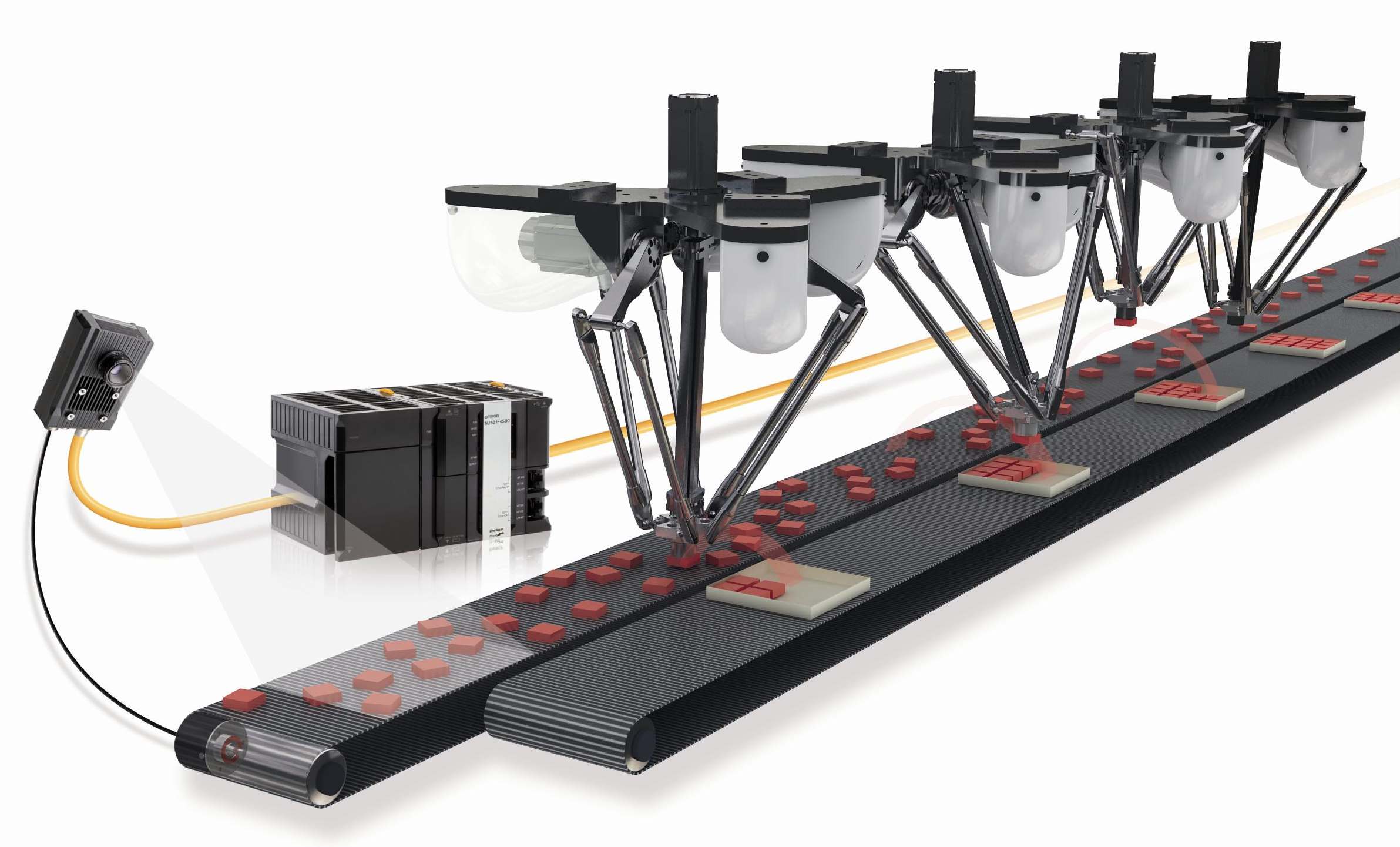
Below a picture of the test setup is depicted, as well as the movies that are recorded during the tests.
The testcases consist of moving two robots on a linear trajectory (in physical space)
towards each other, ending in configurations in which the robots collide. The system is programmed to stop the robots immediately if the robots are colliding and from this we can thus test
whether the algorithms detect correctly when the robots collide.
We created two testcases, where each testcase has a different trajectory. The approaches that were tested in this setup are the SAT algorithm, the linear 6D quadtree and the linear 5D quadtree.
Since the (physical) test setup was designed such that the robots are not able to touch each other, it was impossible to create a testcase in which the robots physically collide. To overcome
this problem, we used a simulator, in which the robots are placed closer to each other and are moved along the exact same trajectory. From this simulator we recorded the motions of the robots, where the
robots are depicted by six gray boxes.
Further, we moved the physical robots over the exact same trajectory and recorded the motions of these robots. To show that the algorithms execute in the simulator as well as the real robotics system in
the same way, we edited the recorded motions of the two environments into one movie. These movies are listed below.
For clarity, we recorded the motions of the robots in the simulator from two different angles: one from the 'front' side, which corresponds to the angle in which we recorded the motions of the physical
robots, and one from the 'top' side, in which it is usually more clear to see that when the robots are stopped, they are nearly colliding.